

AI-Driven Target ID & Molecule Design

Business Challenge: Target identification and lead optimization average 4–6 years and 90%+ attrition before clinical entry. Vast omics, literature, and chemical search spaces overwhelm traditional bench-driven workflows.
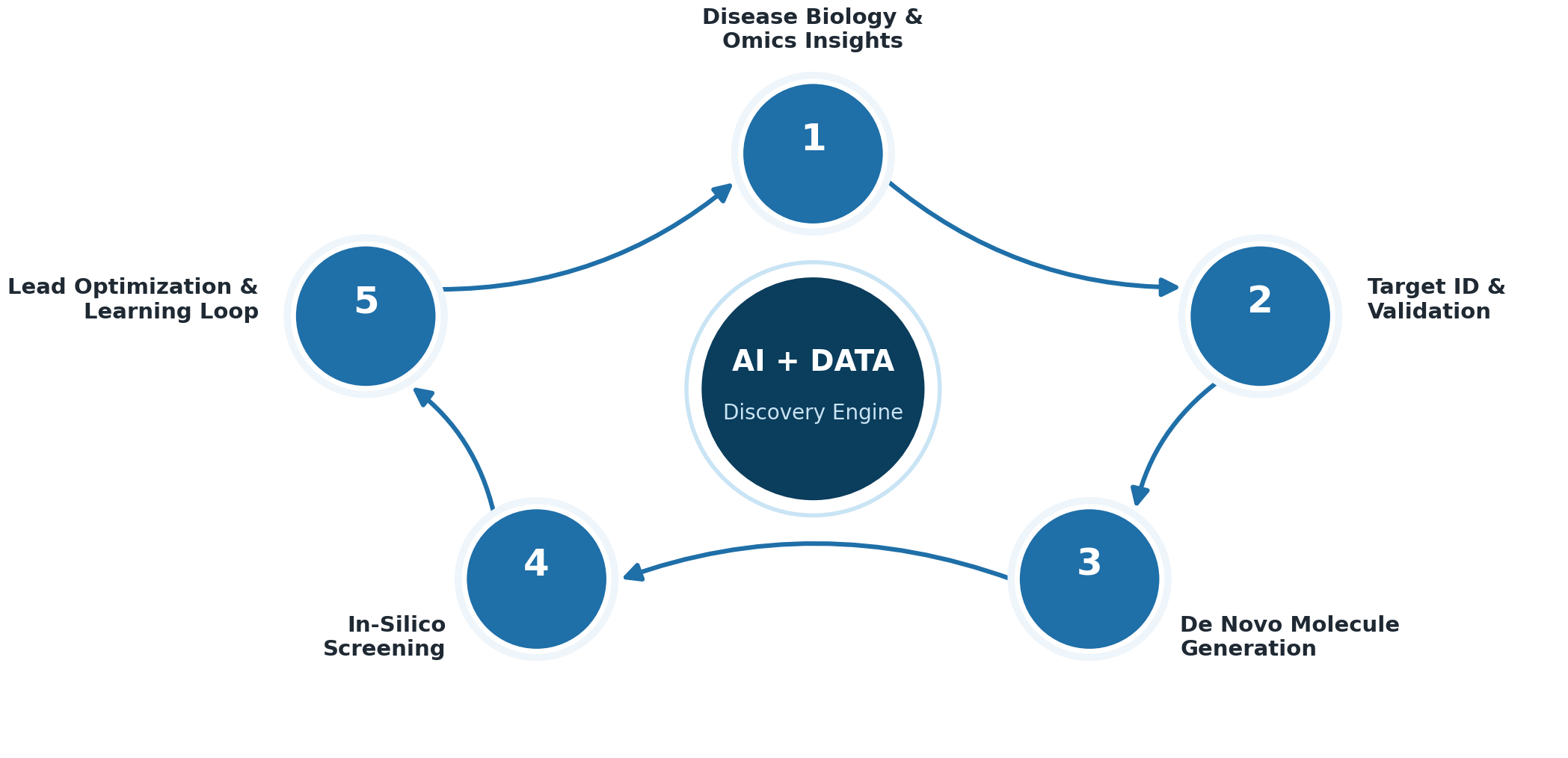
AI-Enabled Solution: Multi-omics + knowledge-graph reasoning surfaces high-confidence targets; generative chemistry designs novel, synthesizable molecules; in-silico ADMET/efficacy models prioritize the best leads — closing the design–make–test–learn loop in days, not months.

MOLECULES, COMPOUNDS & TARGETS IN PLAY

CYCLIC AI-DRIVEN PROCESS FLOW

AI CAPABILITIES
Multi-omics target identification & disease-mechanism mapping
Generative de novo molecule design (diffusion / transformer models)
In-silico ADMET, toxicity & off-target prediction
Biomedical knowledge graph for target–drug–pathway reasoning
Active-learning loop for high-yield experimental screening
BENEFITS & KPIs
Target ID to validated hit−50%
Hit-to-lead cycle time−40%
Synthesis & screening cost−30%
Quality of lead candidates+35%
Reduction in failed assays−45%

KEY DATA SOURCES
Multi-omics (genomics, proteomics, transcriptomics), PubMed/literature, public/private compound libraries, ChEMBL, UniProt, internal HTS data, knowledge graphs

AI & TECH ENABLERS
Generative chemistry models, GNNs, transformer LLMs, AlphaFold-class structure prediction, active learning, MLOps + lab-automation integration